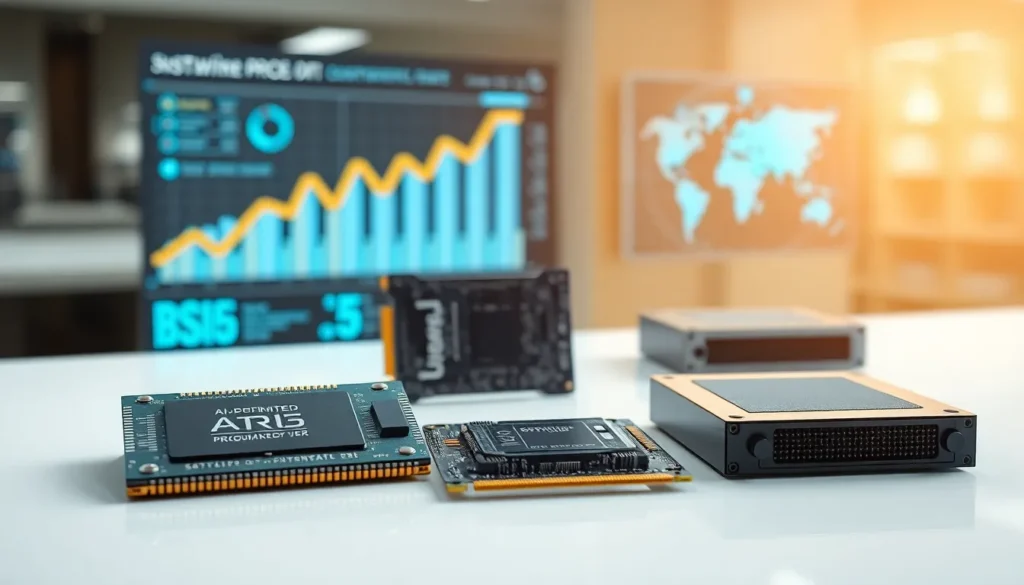
Hardware trends 2026 are shaping up to redefine how devices perform, consume power, and integrate with artificial intelligence. The technology industry stands at a turning point. Processors grow smarter. Memory becomes faster. Quantum systems inch closer to practical use. And sustainability finally moves from buzzword to design priority.
This article breaks down the five major hardware trends 2026 will bring to consumers and enterprises alike. From AI-specific chips to edge computing devices, these developments will influence everything from smartphones to data centers. Here’s what the year ahead holds.
Table of Contents
ToggleKey Takeaways
- Hardware trends 2026 will make AI-optimized processors with NPUs standard across laptops, tablets, and smartphones for faster on-device processing.
- DDR5 memory and PCIe 5.0 SSDs reach mainstream adoption, delivering dramatically faster speeds and making 4TB storage affordable for everyday users.
- Quantum computing hardware advances through cloud platforms, bringing practical applications closer for pharmaceuticals, finance, and logistics industries.
- Energy-efficient 2nm chip manufacturing and GaN power adapters reduce power consumption across devices while extending battery life.
- Edge computing devices become smarter with built-in AI accelerators, enabling real-time local processing for healthcare, manufacturing, and retail applications.
- Sustainability drives hardware trends 2026 as modular designs and right-to-repair regulations push manufacturers toward longer-lasting, repairable products.
AI-Optimized Processors and Chips
AI workloads demand specialized hardware. General-purpose CPUs can’t keep up with the math-heavy operations machine learning requires. That’s why hardware trends 2026 point toward AI-optimized processors as a dominant force.
Chip manufacturers like NVIDIA, AMD, and Intel are doubling down on neural processing units (NPUs). These chips handle matrix multiplications and tensor operations far more efficiently than traditional architectures. Apple’s M-series chips already include NPU cores, and 2026 will see competitors match or exceed this integration.
Expect to see NPUs become standard in laptops, tablets, and even mid-range smartphones. On-device AI processing reduces latency and improves privacy, users won’t need to send data to the cloud for analysis. This shift matters for real-time translation, image recognition, and voice assistants.
Data centers will adopt purpose-built AI accelerators at scale. Google’s TPUs and Amazon’s Trainium chips represent early examples. By 2026, these hardware trends will accelerate as enterprises run larger language models and generative AI applications locally.
The result? Faster inference, lower operational costs, and AI capabilities previously reserved for tech giants becoming accessible to smaller organizations.
Next-Generation Memory and Storage Solutions
Speed bottlenecks often live in memory and storage. Processors can only work as fast as data arrives. Hardware trends 2026 address this gap with significant upgrades to RAM and SSD technology.
DDR5 memory will reach mainstream adoption. It delivers double the bandwidth of DDR4 while improving power efficiency. Gamers, content creators, and data scientists will notice the difference. Applications load faster. Multitasking becomes smoother.
Storage sees equally dramatic improvements. PCIe 5.0 SSDs are hitting the market now, and 2026 will push them into consumer devices at competitive prices. Read speeds exceeding 12,000 MB/s mean operating systems boot in seconds and large files transfer almost instantly.
CXL (Compute Express Link) technology deserves attention too. This standard allows memory pooling across servers, enabling flexible allocation based on workload demands. Enterprises can optimize hardware utilization without over-provisioning individual machines.
For consumers, expect higher-capacity drives at lower price points. The 4TB SSD becomes the new 1TB, affordable and practical for everyday users. These hardware trends 2026 make high-performance storage accessible beyond enthusiast circles.
Advances in Quantum Computing Hardware
Quantum computing remains largely experimental. But hardware trends 2026 signal real progress toward practical applications.
IBM plans to exceed 100,000 qubits by the end of the decade. The company’s 2026 roadmap includes modular quantum systems that connect multiple processors. Google and IonQ pursue similar goals with different approaches, superconducting circuits versus trapped ions.
Error correction represents the biggest challenge. Current quantum systems produce noisy results that require classical computers to verify. New chip designs aim to reduce error rates through improved qubit stability and isolation techniques.
Will consumers buy quantum computers in 2026? No. But enterprises and researchers will access quantum hardware through cloud services. AWS Braket, Azure Quantum, and IBM Quantum already offer this access. By 2026, these platforms will feature more powerful systems and better development tools.
Pharmaceutical companies, financial institutions, and logistics firms stand to benefit first. Quantum algorithms can simulate molecular interactions, optimize portfolios, and solve routing problems faster than classical methods. Hardware trends 2026 bring these capabilities closer to production use.
Sustainable and Energy-Efficient Components
Power consumption matters more than ever. Data centers already consume roughly 1% of global electricity. Hardware trends 2026 prioritize energy efficiency as both an environmental and economic concern.
Chip manufacturers are moving to smaller process nodes. TSMC’s 2nm technology enters production, packing more transistors into less space while reducing power draw. Intel and Samsung follow with competing nodes.
Smaller transistors mean laptops run longer on battery. Servers generate less heat. Cooling costs drop. These improvements compound across millions of devices.
Beyond silicon, companies explore alternative materials. Gallium nitride (GaN) power adapters charge devices faster with less energy waste. They’re already common in premium chargers and will spread to budget options by 2026.
Circular design principles gain traction too. Modular components allow easier repairs and upgrades. Framework’s repairable laptops proved the concept works. Larger manufacturers now follow with similar approaches.
Hardware trends 2026 reflect growing pressure from regulators, investors, and consumers. The EU’s right-to-repair legislation pushes manufacturers toward longer product lifespans. Sustainability isn’t optional anymore, it’s a competitive advantage.
The Rise of Edge Computing Devices
Cloud computing dominates enterprise infrastructure. But sending every data packet to distant servers creates latency and bandwidth costs. Edge computing solves this by processing data closer to its source.
Hardware trends 2026 show edge devices becoming smarter and more capable. Industrial sensors, retail kiosks, autonomous vehicles, and smart cameras all need local processing power. They can’t wait for round trips to the cloud.
NVIDIA’s Jetson platform and Intel’s Neural Compute Stick represent current edge hardware options. By 2026, these products will feature more powerful AI accelerators in smaller form factors. A security camera could run facial recognition locally without external servers.
5G networks accelerate edge adoption. Higher bandwidth and lower latency make it practical to distribute workloads between edge devices and centralized infrastructure. The hardware trends 2026 brings include purpose-built chips for this hybrid architecture.
Healthcare, manufacturing, and retail industries lead edge adoption. Hospitals process patient data locally for privacy compliance. Factories run predictive maintenance algorithms on production lines. Stores analyze shopper behavior in real time. These use cases demand reliable edge hardware, and 2026 delivers it.