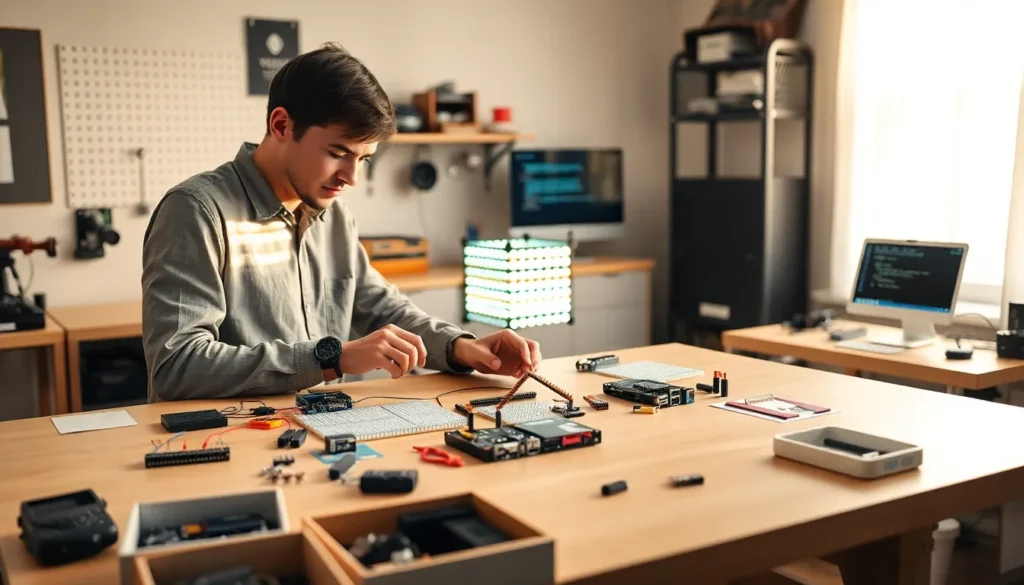
Hardware ideas spark creativity for builders of all skill levels. From smart home gadgets to upcycled electronics, DIY hardware projects offer hands-on learning and practical results. Makers today have access to affordable components, open-source designs, and thriving online communities that make building easier than ever.
This guide covers hardware ideas across four categories: smart home automation, beginner electronics, microcontroller applications, and upcycling projects. Each section provides concrete examples that readers can start building today. Whether someone wants to automate their home, learn soldering basics, or give old tech new life, these hardware ideas deliver real value without requiring an engineering degree.
Table of Contents
ToggleKey Takeaways
- Hardware ideas span four rewarding categories: smart home automation, beginner electronics, microcontroller applications, and upcycling projects.
- DIY smart home projects like automated lighting and plant watering systems cost under $20 and teach practical electronics skills.
- Beginner-friendly hardware ideas such as LED cubes and USB-powered gadgets build confidence through hands-on soldering and circuit fundamentals.
- Arduino excels at real-time control tasks while Raspberry Pi handles complex computing—many hardware ideas combine both platforms.
- Upcycling old electronics reduces waste and provides free components like motors, switches, and enclosures for creative new builds.
- Start with one platform or project type and master it before expanding to more advanced hardware ideas.
Smart Home Automation Projects
Smart home automation stands out as one of the most rewarding hardware ideas for practical-minded builders. These projects combine electronics skills with everyday utility, and they actually save money over buying commercial solutions.
DIY Smart Lighting Systems
Builders can create custom smart lighting using ESP8266 or ESP32 microcontrollers paired with relay modules. A basic setup costs under $15 in parts and connects to WiFi for smartphone control. More advanced hardware ideas include RGB LED strips with addressable pixels, motion-activated hallway lights, or sunrise alarm systems that gradually brighten bedrooms.
The open-source platform WLED makes LED strip control straightforward. Users flash the firmware, connect their strips, and gain access to hundreds of lighting effects through a mobile app.
Environmental Monitoring Stations
Temperature, humidity, and air quality sensors transform homes into data-rich environments. A DHT22 sensor paired with an ESP32 creates a wireless weather station that logs readings to cloud dashboards. Makers who want deeper insights add CO2 sensors, particulate matter detectors, or soil moisture probes for indoor plants.
These hardware ideas scale easily. Start with one sensor in the living room, then expand to a whole-house network that tracks conditions across every space.
Automated Plant Watering
Forgetful gardeners love this project. A simple moisture sensor triggers a small water pump when soil dries out. The entire build uses about $20 in components: an Arduino Nano, capacitive soil sensor, relay module, and submersible pump. Solar-powered versions work great for outdoor gardens without nearby outlets.
Smart home hardware ideas like these teach real skills while solving actual problems. That combination keeps makers coming back for more projects.
Beginner-Friendly Electronics Builds
New makers need hardware ideas that build confidence without overwhelming complexity. These entry-level projects teach fundamentals while producing satisfying results.
LED Cube Displays
A 3x3x3 LED cube serves as an excellent first soldering project. Builders learn to create clean solder joints, understand basic circuits, and program simple animations. The materials cost around $10, and dozens of free tutorials walk through each step. Once complete, the cube displays scrolling patterns, fading effects, and reactive light shows.
Larger cubes (4x4x4 or 8x8x8) offer progression paths for those who catch the building bug.
USB-Powered Gadgets
USB power supplies 5 volts, a safe, convenient electricity source for small hardware ideas. Beginners can build desk fans, phone charging stations, LED reading lamps, or cup warmers using USB connections. No batteries required, no complex power management needed.
A USB-powered LED message board makes a great desk accessory. Scrolling text displays use MAX7219 LED matrices and cost under $8 for all components.
Simple Sensor Projects
Sensors introduce beginners to input-based electronics. A light-activated night light teaches the basics: when the photoresistor detects darkness, the LED turns on. From there, makers explore ultrasonic distance sensors, temperature monitors, or touch-sensitive switches.
These hardware ideas create natural learning progressions. Each project adds new concepts while reinforcing previous lessons. Someone who builds a temperature display today might create a full weather station next month.
Soldering Practice Kits
Commercial soldering kits offer structured practice for complete beginners. Kits range from flashing LED badges ($5) to FM radio receivers ($15) to digital clocks ($20). They provide all components, clear instructions, and predictable results, perfect for building soldering confidence before tackling custom hardware ideas.
Raspberry Pi and Arduino Applications
Raspberry Pi and Arduino boards power countless hardware ideas. These platforms offer different strengths, and smart makers use both.
Understanding the Platforms
Arduino excels at real-time control tasks. It reads sensors, drives motors, and responds instantly to inputs. The platform handles hardware ideas that require precise timing or direct electronic control.
Raspberry Pi functions as a full Linux computer. It runs complex software, connects to networks, processes video, and handles tasks requiring significant computing power. Hardware ideas involving machine learning, media servers, or web interfaces benefit from Pi’s capabilities.
Many projects combine both: Arduino handles sensor input while Raspberry Pi processes data and provides user interfaces.
Popular Arduino Hardware Ideas
- CNC machines and 3D printer controllers – Arduino Mega boards run GRBL firmware for precise motor control
- MIDI controllers – Custom music interfaces for DJs and producers
- Robotic arms – Servo-driven manipulators for pick-and-place tasks
- Weather stations – Outdoor sensors feeding data to indoor displays
- Game controllers – Custom input devices for retro gaming or flight simulators
Raspberry Pi Project Examples
Pi-based hardware ideas often involve complete systems:
- Retro gaming consoles – RetroPie turns any Pi into a classic game emulator
- Network-attached storage – OpenMediaVault creates affordable file servers
- Digital signage – Info displays for businesses, events, or home dashboards
- Security cameras – MotionEye software powers DIY surveillance systems
- Print servers – Old USB printers gain wireless printing capabilities
Getting Started Tips
New makers should pick one platform and learn it well before expanding. Arduino suits those interested in electronics and physical computing. Raspberry Pi appeals to programmers who want hardware connections. Either choice opens doors to hundreds of hardware ideas.
Upcycling Old Hardware Into New Creations
Old electronics contain valuable components waiting for second lives. Upcycling hardware ideas reduce waste while creating unique projects.
Salvaging Components
Dead electronics yield useful parts. Old computers provide power supplies, fans, switches, LEDs, and various connectors. Broken appliances contain motors, heating elements, and sensors. Even non-functional gadgets offer enclosures, displays, and buttons for new hardware ideas.
Desoldering skills make component harvesting possible. A basic desoldering pump costs under $10 and pays for itself quickly. Heat-resistant tweezers help extract surface-mount parts from circuit boards.
Computer Case Conversions
Retro PC cases transform into conversation-starting builds. An old Macintosh SE case houses a modern Raspberry Pi with a period-appropriate CRT filter on its display. Beige tower cases from the 1990s become sleek home servers with custom paint and modern internals.
Smaller conversions work too. Game cartridge shells hold emulators. Calculator cases house modern displays. VHS tape enclosures protect Raspberry Pi media players. These hardware ideas blend nostalgia with modern functionality.
Hard Drive Projects
Dead hard drives contain useful components. The platters make excellent mirrors or coasters. Spindle motors become small fans or generators. The magnets inside are remarkably powerful, useful for tool holders, cable organizers, or magnetic project boards.
Some makers create hard drive clocks by mounting clock mechanisms through the center spindle. Others polish platters into reflective wall art or use them as bases for small sculptures.
Keyboard and Mouse Conversions
Broken keyboards provide mechanical switches, keycaps, and controller boards. Makers create custom macro pads, MIDI controllers, or specialized input devices from salvaged parts. A handful of switches can become a stream deck alternative or a dedicated shortcut controller for video editing.
These upcycling hardware ideas prove that old tech doesn’t belong in landfills. With creativity and basic skills, yesterday’s electronics become tomorrow’s projects.